
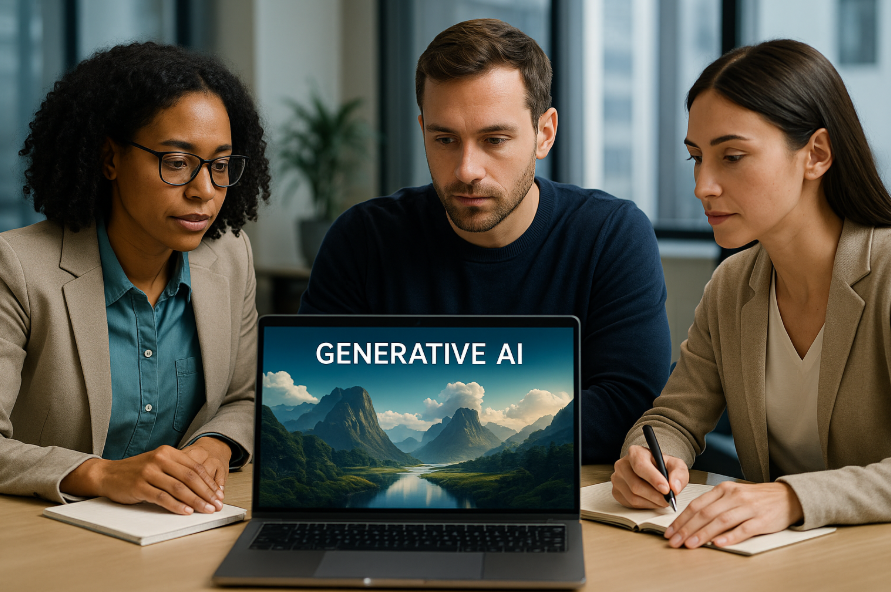
In 2025, Generative AI is no longer a futuristic concept or limited to tech giants it’s now embedded in the daily operations of companies worldwide. From writing emails to generating software code, designing marketing visuals to summarizing meetings, Generative AI tools are transforming how we work across departments, industries, and job functions.
This AI revolution is not about replacing human workers it’s about augmenting their abilities, automating repetitive tasks, unlocking creativity, and making smarter decisions faster. In this blog, we explore the major ways Generative AI is reshaping the modern workplace, highlight the top tools driving these changes, and examine the skills professionals need to stay ahead.
What Is Generative AI?
Generative AI refers to artificial intelligence systems capable of creating new content such as text, images, audio, video, or code based on learned patterns from vast data sets. These tools are powered by models like GPT (text), Stable Diffusion (image), Whisper (audio), and Sora or Runway (video).

Unlike traditional AI, which focuses on classification and prediction, generative AI builds new material often indistinguishable from human-generated content.
How Generative AI Is Transforming the Workplace
Let’s break down the key areas where AI is having the biggest impact:
- Automating Routine Communication
Generative AI is revolutionizing the way professionals write emails, reports, proposals, and internal documentation. Tools like ChatGPT, Jasper, and Microsoft Copilot integrate directly with apps like Outlook, Word, and Teams to generate and refine messages in real time.
Examples:
- Sales reps drafting personalized cold outreach emails.
- HR teams writing internal policy updates.
- Executives preparing presentations with AI-generated slide content.
Impact: Saves hours of manual writing and proofreading while ensuring tone, grammar, and formatting consistency.
- Enhancing Creativity in Marketing & Design
Creative departments now use AI to speed up ideation, design, and copywriting processes. Canva’s Magic Studio, Adobe Firefly, and Runway ML allow marketers and designers to generate campaign visuals, product mockups, or social media posts in minutes.
Examples:
- Auto-generating banner ads with multiple copy/image variations.
- Turning blog posts into branded videos with voiceovers and captions.
- Using AI to brainstorm taglines or blog headlines based on a keyword.
Impact: Creative output increases dramatically while reducing dependency on large teams or external agencies.
- Streamlining Recruitment and HR Operations
Generative AI is reshaping talent acquisition, onboarding, and internal training. Startups like HireVue, Pymetrics, and Eightfold AI use AI to screen resumes, simulate interviews, and even create personalized onboarding materials.
Examples:
- Auto-generating candidate summaries from LinkedIn profiles.
- Creating customized training plans based on job roles.
- Using AI avatars for multilingual onboarding videos.
Impact: Reduces hiring time, improves candidate experience, and scales HR operations without inflating headcount.
- Boosting Software Development with AI Pair Programming
Tools like GitHub Copilot, Replit Ghostwriter, and Tabnine assist developers by auto-completing code, suggesting functions, and debugging in real-time. AI can now write documentation, generate test cases, and even refactor legacy code.
Examples:
- Writing an entire API in seconds from a single prompt.
- Suggesting more efficient algorithms or code snippets.
- Auto-documenting codebases with comments and summaries.
Impact: Increases developer productivity, reduces time-to-launch, and allows more focus on architecture and innovation.
- Improving Customer Support with AI Agents
Chatbots have evolved into conversational agents capable of handling complex customer inquiries, resolving issues, and even upselling products. Intercom, Ada, and Zendesk AI now offer multi-language, AI-powered support with emotional intelligence built-in.
Examples:
- 24/7 support that mimics a live agent’s tone and empathy.
- Auto-summarizing tickets for faster human intervention.
- AI email responders that resolve complaints in minutes.
Impact: Reduces support costs, improves customer satisfaction, and allows human agents to handle higher-level tasks.
- Enhancing Decision-Making with AI Insights
Generative AI doesn’t just create content it also helps interpret data. ChatGPT Enterprise, Notion AI, and Tableau GPT allow teams to ask natural language questions and receive detailed analyses or summaries instantly.
Examples:
- “Summarize last quarter’s sales trends and highlight anomalies.”
- “What are the top 5 churn reasons in our SaaS dashboard?”
- “Write a summary of this 20-page investor report.”
Impact: Democratizes access to insights across the organization, empowering non-technical staff to make data-driven decisions.
- Meeting Productivity with AI Note-Takers and Summarizers
AI tools like Otter.ai, Fireflies, and Zoom AI Companion can now transcribe meetings, identify action items, and send summaries instantly. They even track speaker sentiment and participation.
Examples:
- Instantly generating meeting minutes and follow-up emails.
- Highlighting decision points and blockers in project calls.
- Suggesting calendar invites and task assignments.
Impact: Saves administrative time, reduces meeting fatigue, and improves follow-through on projects.
Top Generative AI Tools Shaping the 2025 Workplace
| Tool | Category | Workplace Use |
| ChatGPT | Text generation | Writing, summarizing, idea generation |
| Jasper | Marketing copy | Ads, emails, product descriptions |
| Canva Magic | Design | Social posts, presentations, visuals |
| GitHub Copilot | Coding | Code generation, debugging |
| Synthesia | Video avatars | Training, onboarding, explainer videos |
| Fireflies.ai | Meeting summaries | Transcripts, action items |
| Notion AI | Productivity | Notes, task management, research |
| Perplexity AI | Search assistant | Internal research and citations |
New Workplace Skills in the Age of AI
Generative AI doesn’t eliminate jobs it changes what skills are valuable. Workers in 2025 are expected to master:
- Prompt engineering – Asking the right questions and giving context to get optimal AI outputs.
- AI literacy – Understanding what AI can and can’t do, including bias and limitations.
- Tool integration – Knowing how to embed AI tools into daily workflows (e.g., Notion + ChatGPT, Slack + Fireflies).
- Ethical awareness – Respecting data privacy, consent, and intellectual property when using AI-generated content.
- Creativity + Critical thinking – Using AI as a launchpad, not a crutch.
Challenges & Ethical Considerations
While the workplace benefits of generative AI are massive, organizations must navigate important challenges:
🔸 Data Privacy & Confidentiality
AI tools must comply with GDPR, HIPAA, and corporate privacy standards. Using enterprise versions (like ChatGPT Enterprise or Microsoft Copilot) helps mitigate risk.
🔸 Job Displacement Concerns
AI will shift some roles but also create new ones. Upskilling and AI augmentation strategies can ease the transition.
🔸 Content Authenticity
Firms must disclose when AI is used to generate content, especially in sensitive communications like journalism, medical guidance, or legal notices.
🔸 Bias & Hallucination
AI systems can produce biased or inaccurate results. Human oversight is essential to verify facts and filter misinformation.
Future Outlook: Human + AI = Superteams
By 2026 and beyond, we’ll see more organizations evolve into human-AI hybrid workplaces, where employees collaborate seamlessly with digital agents.
Think:
- A marketer working alongside a copy-generating AI.
- A software engineer coding with Copilot in real-time.
- A customer service rep with an AI summarizing call history.
- A project manager using AI to track deliverables and team performance.
The most successful professionals will be those who treat AI as a creative partner and productivity enhancer, not a replacement.
Final Thoughts
Generative AI is not just changing the workplace it’s redefining it. From content creation and code generation to decision-making and communication, AI is becoming the new digital colleague across every industry.
While there are valid concerns to address, the benefits productivity, efficiency, and creative empowerment are too powerful to ignore. Companies that adopt AI thoughtfully, train their teams effectively, and align their strategies with innovation will gain a major edge in this new era of work.
Embrace the AI shift. Your smartest teammate in 2025 might not be human but it will help you do your best work yet.
